News
How Bank Branch Closures Could Affect Your Money
If your local branch shut its doors, how much would your daily money routine really change? Recent data on how bank branch closures spread across the US shows this is no longer a rare event, especially in smaller towns and lower‑income neighborhoods. Understanding How Bank Branch Closures Could Affect Your Everyday Money Management is quickly becoming a practical skill, not an abstract policy debate.
Nationally, branches are declining, but the impact is uneven. Total branches fell about 5.6% from 2019 to 2023, while banking deserts expanded by 217 areas, affecting around 760,000 more people. Some customers barely notice a closure. Others suddenly face longer travel, higher fees, or confusing digital tools for basic tasks.
This article explains what is happening, who feels it most, and how your routines might shift. You will see how bank branch closures affect cash access, bill‑pay, small businesses, and vulnerable households, along with your rights under FDIC rules and five practical steps to keep your everyday money management running smoothly.
Table of Contents
- Why Your Branch Might Disappear
- From Branch Networks to Banking Deserts
- Why Banks Keep Shutting Branches
- How Bank Branch Closures Change Routines
- Daily Life With Fewer Branches
- Communities Hit Hardest by Closures
- Banking Deserts and Why They Matter
- Protections When a Branch Closes
- Five Steps to Rewire Your Money Routine
- How Bank Branch Closures May Evolve
- Frequently askedquestions.
- What This Means for Your Money Today
- Sources
Key Takeaways
- Branch numbers are falling nationwide, but the harshest effects concentrate in new and growing banking deserts.
- Everyday tasks like cash deposits, bill‑pay, and resolving disputes often become slower or more expensive after a closure.
- Older adults, disabled consumers, cash‑dependent workers, and very small businesses face the biggest disruptions.
- FDIC rules give you notice and protect your deposits, even when branches close or banks merge.
- A simple five‑step plan can stabilize your day‑to‑day finances before or after a closure.

When your local branch goes dark, the change feels personal long before it shows up in the national statistics and policy debates.
News Context
Why Your Branch Might Disappear
Across the US, how bank branch closures unfold now looks less like a blip and more like a long shift. The national branch network shrank about 14.8% between 2017 and 2025, from 86,469 to 73,649 locations. During the pandemic peak, closures averaged roughly 200 net branches per month.
From 2024 to 2025, net closures slowed sharply to 584 branches in total, not thousands. That slowdown can make it seem like the problem is easing. But closures continue to accumulate over time, and the pattern is changing: more exits from communities already under strain, and heavier losses for certain regions.
The Federal Reserve Bank of Philadelphia finds that from 2019 to 2023, closures expanded the number of US banking deserts by 217.[1] Around 760,000 additional people now live in areas where a full‑service branch is far away. The gap between a mild inconvenience and a serious barrier often depends on your income, health, and comfort with digital banking tools.
Big Picture
From Branch Networks to Banking Deserts
To understand how bank branch closures affect communities, it helps to zoom out to the national map. The Philadelphia Fed’s research shows a 5.6% decline in branches from 2019 to 2023, but that average masks sharper drops in some rural counties and urban neighborhoods. Banking deserts are areas where the nearest brick‑and‑mortar branch sits beyond common travel distances.
Different researchers define deserts differently, but the idea is simple. Many customers still rely on reasonable driving or walking distances for key services, and closures that stretch those distances can push people toward high‑fee alternatives. The Philadelphia Fed finds both deserts that existed before 2019 and a measurable growth in new deserts since then.
At the same time, a large share of customers say they now prefer digital tools. WSJ Buy Side, citing an American Bankers Association survey, reports that only about 9% of consumers choose branches as their main banking method, while roughly three‑quarters prefer mobile or online. That helps explain how bank branch closures keep moving forward: for many people, the trade‑off looks acceptable, until they run into a task that really needs in‑person help.

As branches disappear, everyday money management shifts to the kitchen table, blending cash, cards, and banking apps into a new routine.
Closures Drivers
Why Banks Keep Shutting Branches
Banks often frame closures as a response to customer behavior. When so many people deposit checks by phone and pay bills online, it is cheaper to rely on apps and call centers than maintain a high‑cost physical network. How bank branch closures fit into long‑term cost cutting is clear when you look at national numbers that show a steady decline, not just a pandemic blip.
Self Financial, using FDIC data, shows a long downward trend in total US branches over the last decade.[2] One scenario in that analysis suggests that if the most aggressive closure pace continued, the US could reach zero physical branches by 2041. Self Financial stresses this is a projection built from past data, not a prediction, but it highlights the direction of travel.
Digital‑only banks, mergers, and consolidations are also key. When banks merge, they often close overlapping locations, especially in higher‑cost urban areas. For a bank, one well‑used branch plus strong digital tools may look better than three half‑empty branches. For customers who still need cash services or in‑person advice, those decisions can translate into long bus rides or new fees at non‑network ATMs.
Everyday Impact
How Bank Branch Closures Change Routines
To see How Bank Branch Closures Could Affect Your Everyday Money Management, start with the simple weekly tasks you handle today. Many people use branches mainly for cash, deposits, and the hardest problems—fraud, disputes, or loan questions—while relying on apps for everything else. When a nearby branch shuts, those remaining in‑person moments become harder to reach.
Here is a quick side‑by‑side look at everyday tasks before and after a closure:
| Task Type | Before Closure | After Closure Nearby | After Closure, Desert Area |
|---|---|---|---|
| Cash Access | Short walk to branch | Use network ATM | Long trip or fee ATM |
| Deposits | Teller or ATM visit | ATM or mobile check | Non‑bank check‑casher use |
| Bill‑Pay | In‑branch or online | Mostly online | Money orders, cash services |
| Advice/Problems | Face‑to‑face visit | Phone or video call | Long travel or call center |
Consider a city commuter paid partly in cash tips. Before closure, they drop deposits at a branch near work three times a week. After closure, they might keep more cash at home, visit a non‑network ATM with $4 fees, or use a check‑cashing shop that takes a cut from each paycheck. Each workaround eats into their budget and time.
A rural worker might face a 20‑minute drive each way for a deposit that used to take 5 minutes. A caregiver helping an older parent could suddenly need to book paratransit or take unpaid time off work just to handle a lost card or change account signers. This is how bank branch closures convert a background trend into real pressure on everyday money management.
Human Stories
Daily Life With Fewer Branches
Stories from research help explain how bank branch closures land differently across households. The Federal Reserve Bank of St. Louis finds that in many places, alternative branches remain within several miles, which softens the blow if you drive and feel comfortable online.[3] But when the nearest full‑service branch moves far away, the routine strain becomes visible.
Picture an urban low‑income neighborhood that loses its last branch. The empty storefront sits between payday lenders and check‑cashing outlets. Without affordable in‑person banking, more people pay to cash paychecks, buy money orders for rent, or rely on prepaid cards with monthly fees. Over a year, those costs can add up to hundreds of dollars for a family already stretched thin.
In another town, an older resident who has always used tellers must switch to direct deposit after a closure. With help from a relative, they set up mobile banking but still prefer to withdraw cash in person. A longer trip for every withdrawal makes them visit less often and withdraw larger sums, raising the risk of carrying more cash and complicating budgeting.
“
The impact of a branch closure often shows up first in small hassles that quietly raise the cost of staying on top of your money.
Those day‑to‑day shifts matter as much as national averages. They shape whether you pay bills on time, avoid overdraft fees, or manage to keep a small emergency fund intact month after month.
Who Hurts
Communities Hit Hardest by Closures
How bank branch closures affect people depends strongly on age, income, disability, and business size. New banking deserts and heavy closure zones often line up with lower‑income and older communities. Residents in these areas are more likely to rely on cash, have limited broadband, or face mobility challenges.
Older adults may struggle with small screens, passwords, or fear of online scams. Disabled consumers can face accessibility barriers in both branch design and digital tools, so losing a familiar branch removes a known, workable option. For some, video calls do not replace a teller who understands their communication needs or mobility constraints.
The National Community Reinvestment Coalition highlights another group under pressure: very small local businesses.[4] NCRC analysis finds that when branch density falls by 8%, small‑business lending can drop about 22%, based on federal data. Owners of salons, food trucks, and corner stores may lose long‑standing relationships with local bankers, face tougher credit decisions from distant lending teams, and spend extra time transporting cash to safer locations.
Cash‑dependent workers in service jobs or gig roles can also feel squeezed. Without a branch nearby, they might rely more on fee‑based services to handle their income, eroding already modest margins. This is where understanding how bank branch closures ripple through a neighborhood becomes vital for local policymakers and consumers alike.
Desert Basics
Banking Deserts and Why They Matter
A banking desert is an area where residents have no nearby full‑service bank branch within a commonly accepted distance. The Federal Reserve their number grew by 217 between 2019 and 2023, leaving about 760,000 more Americans in places where banking in person is hard to reach.
Distance thresholds vary. Some researchers, including the Federal Reserve Bank of St. Louis, focus on several miles as a practical driving distance, while others consider walking or transit options in dense cities. What matters for everyday money management is not the exact mile count, but whether a typical resident can reach a branch without major cost or time burdens.
As deserts grow, people often turn to non‑bank options. That can mean higher fees for cashing checks, sending money, or loading prepaid cards. Over time, limited access to mainstream banking also makes it harder to build a credit history, qualify for lower‑rate loans, or save consistently in insured accounts. This is a key way how bank branch closures shape long‑term financial health, not just this month’s bill‑pay routine.
Communities in emerging deserts sometimes respond with credit unions, shared branches, or local programs that bring banking services into community centers. These efforts can help, but they rarely fully replace the range of services lost when a major branch exits.
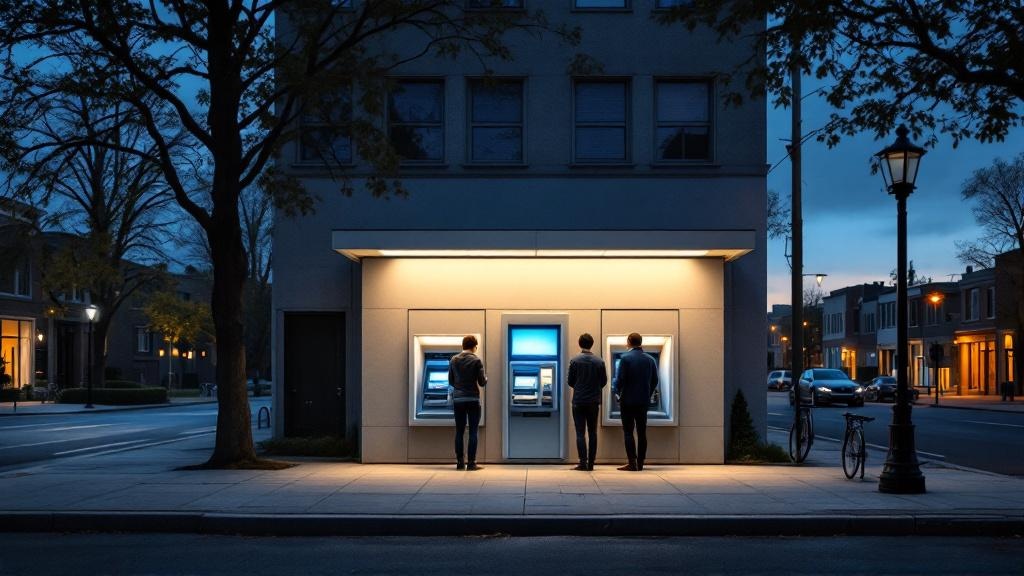
As full-service branches fade, illuminated ATMs and phones become the new front doors to everyday banking for many neighborhoods.
Your Rights
Protections When a Branch Closes
When your branch closes or relocates, FDIC rules give you specific protections.[5] Banks must provide advance notice of a closure or relocation, often at least 90 days before the change, including clear information in the branch and sometimes by mail or digital message. This is designed to give you time to adjust your accounts and routines.
FDIC guidance also stresses that your deposit insurance coverage does not disappear when a branch closes or your bank merges with another institution. As long as your bank remains FDIC‑insured and your balances stay within coverage limits, your money remains protected. During mergers, FDIC explains that accounts and automatic payments usually transfer automatically, though details can vary.
If you have concerns about how bank branch closures were handled in your area—such as lack of notice, accessibility issues, or confusion about accounts—you can raise complaints with your bank first, then with federal regulators if needed. FDIC suggests keeping copies of letters, emails, and statements during a transition so you can track any errors or disputed charges.
Understanding these rights helps you focus on the practical work of managing your day‑to‑day money, instead of worrying that your funds are “less safe” after a closure.
Practical Steps
Five Steps to Rewire Your Money Routine
Here is a five‑step process to protect your everyday money management before or after a closure. This is where how bank branch closures meet your actual calendar, paycheck, and bills.
- Map your current routines
Write down everything you currently use a branch for: cash withdrawals, deposits, cashier’s checks, money orders, in‑person advice. Note how often you do each task and at what times of day.
- Check digital tools and ATM networks
Review your bank’s mobile app, website, and ATM map. Ask about fee‑free ATMs, cash‑deposit machines, extended hours, and any temporary ATM fee waivers after closures. This step shows what you can realistically shift online.
- Secure your income and bill‑pay
Ensure your paycheck uses direct deposit where possible. Set up or adjust automatic payments for rent, utilities, and credit cards so you are not relying on last‑minute branch visits. For cash‑based income, look into mobile check deposit limits and hold times.
- Consider accessibility and internet limits
If you or a family member has limited internet access, plan hybrid strategies. That might include using library or community‑center internet for some tasks, choosing a bank with a closer branch even if it is not the absolute cheapest, or working with a local credit union that offers in‑person support and some digital features.
- Decide whether to switch banks
Compare options based on branch and ATM proximity, digital banking quality, fees, customer service, and accessibility. Look for banks or credit unions that keep at least one branch within a practical distance and that explain clearly how bank branch closures in their network might affect you in the future.
For Oodlz readers, this planning also ties into how you stack benefits. If you switch banks or cards, review how your new setup works with cashback tools so that moving away from a closing branch does not accidentally cut into rewards that support your monthly budget.
Future Outlook
How Bank Branch Closures May Evolve
Looking ahead, how bank branch closures develop over the next decade will likely differ by region and customer type. Self Financial’s analysis of FDIC data shows a scenario where aggressive closure trends could push the US toward zero branches by 2041, but that model assumes no strategic shift or new branch formats. In reality, both banks and regulators are watching how closures affect access.
Closure rates have already slowed sharply between 2024 and 2025. Banks are experimenting with smaller, more automated locations, co‑located services, and shared hubs that several institutions use together. For many customers, the future may involve fewer full‑service branches but more ATMs, video tellers, and appointment‑based visits.
For consumers, the key is to treat branches as one part of a mix. Expect to rely more on digital tools, but still plan for situations where in‑person help matters, such as large cash transactions, complex disputes, or major loans. Thinking about how bank branch closures intersect with your own life stage, health, and work now makes it easier to adjust later if more local branches disappear.
Do I have to move my money when my branch closes?
Your account typically stays open with the same bank, just reassigned to another branch or regional center. Your account number and direct deposits often continue without changes, though you should read any notices closely to confirm.
Can I still deposit cash or checks without a local branch?
In many cases, yes. Banks often rely on ATM cash deposits, mobile check deposit, and mail‑in options after closures. The challenge is higher in banking deserts, where how bank branch closures reduce nearby ATMs can push you toward fee‑based check‑cashers or longer trips to deposit funds.
Will my loan terms change when a branch shuts?
A branch closure by itself does not usually change your loan interest rate, payment schedule, or balance. Those terms are set by your loan agreement. If your bank merges or sells a loan portfolio, the new lender must inform you of any servicing changes, but FDIC notes that your basic contract terms normally stay the same.
What if I do not have reliable internet at home?
Limited internet makes it harder to rely on digital banking alone. Consider banks or credit unions that still keep a reachable branch, even if you need to travel occasionally. You can also combine phone banking, mailed checks or money orders, and scheduled in‑person visits to handle the most important tasks despite how bank branch closures shift local options.
How can I tell if my community is becoming a banking desert?
Warning signs include consecutive branch closures from multiple banks, fewer local ATMs, and more residents relying on check‑cashers or payday lenders. The Philadelphia Fed’s work on deserts shows that as closures cluster in low‑income or rural areas, basic money management becomes more expensive and time‑consuming for residents.
Does a branch closure make my money less safe?
No, as long as your bank remains FDIC‑insured and your balances stay within insurance limits. FDIC emphasizes that insurance applies to the bank, not each branch building. Even as how bank branch closures reshape local access, insured deposits remain protected in the same way across the institution.
Next Steps
What This Means for Your Money Today
The numbers behind bank closures can feel distant, but the reality shows up in small, practical ways: longer trips for cash, new fees at far‑away ATMs, or confusion about where to go with a serious account problem. Understanding How Bank Branch Closures Could Affect Your Everyday Money Management helps you spot those pressure points early and plan around them.
Start by mapping your current routines, checking what your bank offers beyond the branch, and deciding whether a different institution would better match your needs if your local office disappears. If you support older relatives or run a small business, take time now to talk through options so a sudden closure does not disrupt paychecks or rent. For Oodlz users, that same review is a good moment to check that your banking setup still works smoothly with your favorite cashback tools, so you keep earning rewards while adapting to a world with fewer branches.