News
Hidden Relief Inside the Loneliness Epidemic
On a Tuesday night in a church basement, twelve adults go around saying why they came. One admits they almost did not walk through the door because “everyone else seems fine.” Heads around the circle nod a little too quickly. In a country wrestling with a loneliness epidemic, this scene is far more common than it looks from the outside.
Across age groups and income levels, people describe the same quiet feeling: being overwhelmed, behind, or breaking inside while others appear to be coping. New data shows this is not a private failure but a shared condition. The pressure of modern life, social media, and post‑pandemic fallout has made silent struggle almost a default setting.
This news feature looks at what the numbers say about our collective state, why struggle stays hidden, and why learning you are not the only one can bring real, if complicated, comfort. It examines The Hidden Relief Of Discovering Everyone’s Quietly Struggling Too and how that realization can shift us from shame to connection, and from slogans to action.
Table of Contents
- When the Mask Finally Slips
- Inside Today’s Loneliness Epidemic
- How Many Are Quietly Struggling
- Why Everyone Else Looks Fine
- Loneliness as Public Health Issue
- What Changes When You’re Not Alone
- How the Loneliness Epidemic Offers Insight
- Isolated Struggle vs Shared Support
- From Quiet Drowning to Connection
- Frequently askedquestions.
- A Different Story About Struggle
- Sources
Key Takeaways
- In fresh U.S. And global data, emotional distress and loneliness are the norm, not the exception.
- The loneliness epidemic is fueled by social media, stigma, economic strain, and post‑COVID aftershocks.
- Realizing others are quietly struggling can reduce self‑blame and open the door to connection.
- Saying “you’re not alone” helps only when backed by honest conversation, support, and better policies.
- Small acts of disclosure and outreach can turn shared struggle into real community support.
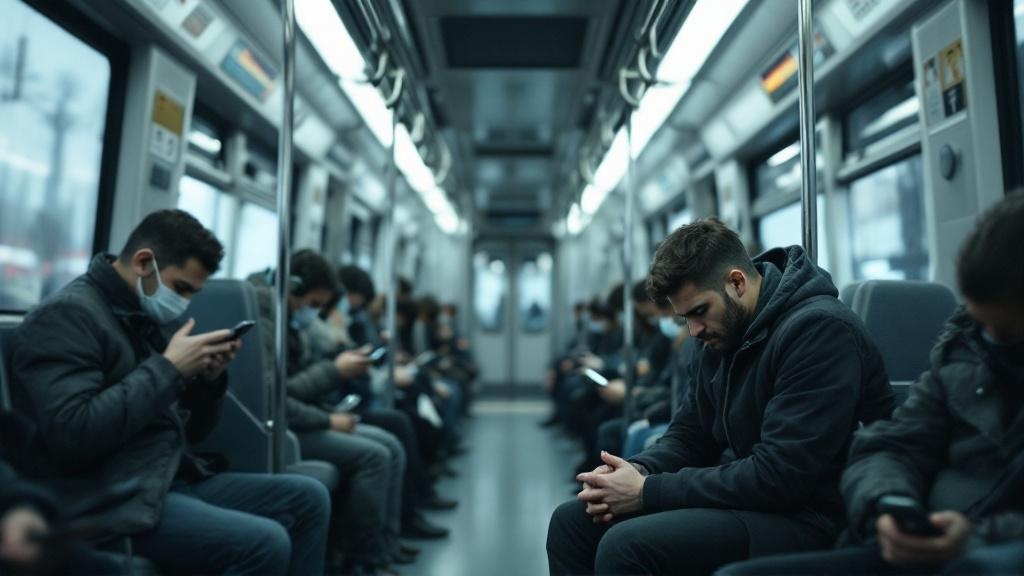
A crowded train can feel like the loneliest place—everyone absorbed, everyone carrying something you can’t quite see.
Basement Moment
When the Mask Finally Slips
The church‑basement group meets every week in a midwestern city. Some are caregivers, some are young professionals, some are retired and recently widowed. The official topic is stress and mental health, but most people begin by talking about work, bills, sleep, and scrolling.
Over several sessions, a pattern emerges. Each person assumed they were the worst‑off in the room. A 32‑year‑old graphic designer thought she was the only one stuck in bed until noon on weekends. A 58‑year‑old caregiver believed no one else lay awake rehearsing disaster scenarios about money and health.
Their stories echo a common online scene. On Reddit threads, group chats, and late‑night DMs, people confess they feel like they are “quietly drowning” while others are thriving. This disconnect between appearance and reality sets the stage for both the loneliness epidemic and the strange comfort that comes from finally seeing what others carry too.
In that basement, something shifts the night one man says, “I thought I was uniquely failing.” His words land with visible relief. People laugh, a bit bitterly, then start describing their own panic attacks, collection notices, and stalled careers. The room is still heavy, but it is no longer silent.
Hidden Crisis
Inside Today’s Loneliness Epidemic
Across the United States, mental‑health and loneliness data point to a quiet emergency. According to NAMI, 23.4% of U.S. Adults experienced a mental illness in 2024, and 5.6% lived with a serious mental illness. That means nearly one in four adults are dealing with significant psychological distress in any given year.
21% of U.S. Adults say they often or always feel lonely. Among those lonely adults, 81% also report anxiety or depression and about 75% say they have little or no sense of meaning or purpose. The loneliness epidemic does not sit on its own; it clusters with other forms of pain.
Globally, the pattern is just as stark.[1] More than 1 billion people are living with mental‑health conditions, with anxiety and depression the most common. These conditions cut across regions, income levels, and ages, adding weight to the idea that “everyone is struggling” is closer to a statistical summary than a comforting slogan.
Older adults are often assumed to be better insulated by long‑standing communities, but recent data disputes that. AARP reports that 40% of U.S. Adults ages 45 and older describe themselves as lonely, up from 35% in both 2010 and 2018. The loneliness epidemic has deepened over time, turning from a background concern into a defining feature of 2020s life.

Behind the calm surface, everyday objects quietly map the overlapping pressures so many people are carrying at once.
By the Numbers
How Many Are Quietly Struggling
For people who wonder whether “everyone is struggling” is exaggeration, the latest figures provide a clearer picture. Mental illness, loneliness, and lack of purpose show up together in surprising numbers.
Here is a snapshot of current data:
- NAMI says about 1 in 4 U.S. Adults experience a mental illness in a given year.
- Harvard Making Caring Common finds 21% of adults report frequent loneliness.
- Among lonely adults, 81% report anxiety or depression and 3 in 4 lack meaning.
- AARP estimates 40% of adults 45+ now feel lonely.
- WHO reports more than 1 billion people worldwide live with mental‑health conditions.
In interviews about the Harvard report, project leaders describe loneliness as a broad, social problem embedded in how we live and work.[2] They emphasize that people can sit in offices, classrooms, and family homes and still feel deeply alone. The loneliness epidemic is not just about being physically isolated; it is about feeling emotionally unseen where you already are.
The Oregon State University study on social media and loneliness adds another piece. U.S. Adults in the top quarter for social media use were more than twice as likely to report loneliness compared with light users, even after adjusting for demographics. Constant connection does not appear to reduce the loneliness epidemic; for many, it intensifies it.
Mask Illusion
Why Everyone Else Looks Fine
If all these numbers are real, why do so many people believe they are the only ones falling apart? One reason is what psychologists call impression management: the work people do to appear competent and calm. In workplaces, on social media, even in family group texts, people share promotions, vacations, and milestones more than panic attacks or overdue bills.
Social media intensifies this distortion. The Oregon State University research on social media and loneliness suggests that frequent users spend more time comparing their lives to curated images of others. Even small glimpses of other people’s stress are drowned out by photos of neat apartments, smiling children, and productivity hacks, which hide the loneliness epidemic behind filters and captions.
Stigma around mental illness and money problems also keeps struggles quiet. NAMI notes that many people delay seeking help for years because they fear being seen as weak, unstable, or burdensome.[3] In everyday life, that stigma shows up as jokes about “being crazy” instead of frank talk about diagnosis or treatment.
Economic and cultural pressures add another layer. Reports from Harvard emphasize long work hours, financial precarity, and “always on” expectations as drivers of disconnection. People work more to stay afloat, have less time for friends or family, and feel ashamed if they cannot keep up. The result is a widely shared but rarely spoken story: the loneliness epidemic thrives in the gap between how life feels and how it is supposed to look.
Quiet Epidemic
Loneliness as Public Health Issue
Public‑health researchers now describe the loneliness epidemic as a serious health issue, not just an emotion. Harvard Making Caring Common distinguishes between social‑emotional loneliness (lack of close, trusting relationships) and existential loneliness (a sense that life lacks purpose or meaning). Many people report both at once.
In the Harvard data, loneliness strongly overlaps with other mental‑health problems. The fact that 81% of lonely adults report anxiety or depression suggests that feeling isolated is part of a larger cluster of distress. When about three‑quarters say they lack meaning, it reflects a deeper sense that their lives are disconnected from support, value, or hope.
The AARP report on adults 45 and older links loneliness to physical health, citing associations with higher risk of heart disease, stroke, and cognitive decline.[4] When researchers call the loneliness epidemic a public‑health crisis, they point to these compounding effects: emotional pain that quietly undermines bodies, relationships, and communities.
Technology plays a complicated role. The Oregon State University findings do not argue that social media causes loneliness by itself, but that heavy, frequent use is linked with higher odds of feeling lonely. For someone already isolated, scrolling through others’ apparent success can make their own hidden struggles feel even more shameful and unique.
“
When people realize their pain is widely shared, the story often shifts from “What is wrong with me?” to “What is happening to us?”
That shift is at the core of The Hidden Relief Of Discovering Everyone’s Quietly Struggling Too. It does not erase the loneliness epidemic, but it changes the meaning people attach to their own distress, which can be a first step toward seeking support.
Hidden Relief
What Changes When You’re Not Alone
Mental‑health advocates hear a common sentence at support groups and education classes: “I wish I had known sooner that other people feel this way.” NAMI staff describe how, in peer programs, participants often arrive convinced their reactions are abnormal. By the end of a session, they see their panic, numbness, or anger echoed around the room.
Part of the hidden relief comes from reduced self‑blame. If 23.4% of adults experience a mental illness in a year, your anxiety or depression is not proof of personal weakness. It is evidence that you are a human being living through a period marked by a loneliness epidemic, economic strain, and global uncertainty.
Another part is normalization of distress in abnormal conditions. Over 1 billion people worldwide live with mental‑health conditions, it reframes the problem as global and structural. The question becomes less “Why can’t I cope?” and more “Why are so many of us under this level of pressure?”
There is also a social element. In the church‑basement group, once several people share stories of panic in grocery store aisles or dread on Sunday nights, small moments of humor appear. One caregiver jokes about “having an advanced degree in pretending” and others laugh because they recognize themselves. That laughter does not fix anyone’s life, but it creates a sense of village inside the loneliness epidemic.
At the same time, advocates warn about a “frustration” layer inside this relief. People can feel comforted that others understand them and angry that so many are left without adequate treatment, time off, or affordable care. Recognizing shared struggle can highlight the gap between how widespread the problem is and how limited the support remains.
Shared Relief
How the Loneliness Epidemic Offers Insight
The idea that “everyone is struggling” can sound like empty comfort, but in the context of the loneliness epidemic it can also be a lens. It helps explain why so many people report feeling behind and disconnected even when they have jobs, families, or followers.
In mental‑health settings, peers often talk about a three‑step shift: first, “I am broken”; then, “I am struggling in the same way millions of others are”; finally, “We are living in conditions that strain almost everyone.” Each step moves the focus slightly outward, from isolated self‑criticism toward shared reality.
This perspective does not cure depression or anxiety. It does challenge the belief that your reactions are bizarre or shameful. When Harvard, AARP, NAMI, WHO, and Oregon State University all describe rising distress, it suggests a broader story: the loneliness epidemic is less a personal failing and more a social signal that something about modern life is misaligned with human needs.
At the same time, the phrase can be misused as a way to minimize pain. People sometimes hear “everyone is struggling” as “so stop complaining.” The difference lies in what comes next: either the recognition becomes a reason to dismiss suffering, or it becomes an argument for more care, more flexibility at work, and better mental‑health services.
Comparison Lens
Isolated Struggle vs Shared Support
One way to understand the impact of the loneliness epidemic is to compare what happens when struggle stays private versus when it becomes shared and supported. Researchers and advocates often draw this distinction when designing programs and policies.
Here is a simple framework:
| Mode of Experience | Story You Tell Yourself | Typical Feelings | Likely Outcomes | Social Message |
|---|---|---|---|---|
| Isolated struggle | “It’s just me” | Shame, secrecy | Withdrawal, burnout | “Cope on your own” |
| Shared struggle | “It’s not only me” | Relief, recognition | Openness, help‑seeking | “Your pain makes sense” |
| Toxic normalization | “Everyone suffers, so be quiet” | Resentment, numbness | Stuckness, cynicism | “Struggle is normal, accept it” |
| Collective responsibility | “We’re all strained, we can change this” | Motivation, solidarity | Mutual aid, advocacy | “We deserve better support” |
Experts say the goal is not to romanticize shared pain, but to move away from isolated struggle and toxic normalization. In a loneliness epidemic, the most hopeful path is toward shared struggle paired with collective responsibility, where people both feel less alone and push for better conditions.
Tiny Steps
From Quiet Drowning to Connection
For individuals, the path from “I am quietly drowning” to “I am part of a larger, shared struggle” often begins with very small steps. People in NAMI support groups describe a simple process that repeats across settings, from community centers to workplace discussion circles.
First, there is a moment of naming. This can be telling a friend, writing a message to a helpline, or simply saying aloud, “I am not okay.” In the context of a loneliness epidemic, this step counters the pressure to keep up appearances at all costs. It moves feelings out of silent, internal monologue and into words.
Second, there is the discovery of others who say, “Me too.” That might come through a formal support group, an online community, a religious congregation, or an honest conversation with a coworker. The striking part, people report, is not just overlap in symptoms but overlap in pressures: debt, caregiving, burnout, grief, social media exhaustion.
Third, there is action, often modest but meaningful. Someone might block an hour a week for a standing walk with a friend, join a community class, or talk to a manager about workload. In a society marked by a loneliness epidemic, these steps can feel small, but repeated across many people, they change the texture of daily life.
Finally, some move into advocacy. After realizing their experience matches statistics from Harvard, NAMI, AARP, WHO, or Oregon State University, they write to local officials, push for mental‑health benefits at work, or support school programs that teach emotional skills. Their personal story becomes a small part of a broader effort to respond to the loneliness epidemic instead of simply enduring it.
Is everyone really struggling, or is that exaggerated?
Data from NAMI, Harvard Making Caring Common, AARP, WHO, and Oregon State University shows high rates of mental illness and loneliness across age groups. That does not mean every person is in crisis, but the loneliness epidemic and related distress are common enough that feeling underwater is statistically normal, not rare.
Why do other people look fine when I feel broken?
People often hide struggle because of stigma, fear of judgment, or workplace expectations. Social media highlight reels and professional “masking” make the loneliness epidemic harder to see, so you mostly notice your own low points and others’ polished moments.
Why does knowing others are struggling feel comforting?
Realizing others share your experience reduces self‑blame and isolation. In the context of a loneliness epidemic, it reframes your feelings as understandable responses to pressure rather than proof that something is uniquely wrong with you.
Can saying "you’re not alone" ever be harmful?
It can feel hollow if it stops at words. If “you’re not alone” is used to dismiss complaints or deny the need for support and policy change, it slides into toxic normalization instead of genuine comfort.
What practical steps can help me feel less alone?
Small actions help: telling one trusted person the truth, joining a support group or community activity, and limiting social media that worsens comparison. These steps do not erase the loneliness epidemic, but they create pockets of connection and relief.
How does social media affect the loneliness epidemic?
The Oregon State University study found heavy social‑media users were more than twice as likely to report loneliness. Constant exposure to others’ curated lives can intensify self‑comparison and make your own hidden struggles feel more isolating.
Closing Reflection
A Different Story About Struggle
The church‑basement group eventually stops spending the first half of every meeting pretending to be fine. New members still arrive saying they thought they were uniquely failing, but they hear a chorus of familiar stories waiting for them. The room holds the same grief, debt, and exhaustion, yet the silence around it is thinner.
The data behind the loneliness epidemic points in the same direction. When one in four adults faces mental illness in a year, 21% report frequent loneliness, and over 1 billion people worldwide live with mental‑health conditions, the story shifts. The Hidden Relief Of Discovering Everyone’s Quietly Struggling Too lies in trading private shame for an accurate picture of how many lives feel heavy.
For readers, the next step may be modest: one honest text, one group meeting, one workplace conversation that allows a crack in the mask. For communities and institutions, it means treating widespread distress as a signal to build more support, not as background noise. In a time when the loneliness epidemic touches so many, choosing to speak about it is a small but real act of care.