Marketplaces
Selling Vinyl Records: What Collectors Want in 9 Steps
Vinyl is booming again. Recording Industry Association of America data shows U.S. Vinyl albums hit about $1.2 billion in 2022 and even outsold CDs in units. If you are staring at boxes of LPs and wondering about selling vinyl records: what should you do first, and where should you list them?
Because demand is rising and online retail is the fastest‑growing vinyl channel, according to Introspective Market Research, your timing is good. But not every record is valuable, and not every marketplace fits your goals. The wrong choice can mean wasted evenings, damaged shipments, or records that never sell.
This guide walks you through Selling Your Vinyl Records: What Collectors Look For and Where to Start, step by step. You will learn how collectors think, how to triage and value your records, and which marketplaces or local options fit different collections. By the end, you will have a clear action plan from first box inspection to successful shipment.
Table of Contents
- What Collectors Actually Care About
- Selling Vinyl Records: What To Triage First
- Valuing Records Without Losing Weeks
- Selling Vinyl Records: What Marketplace Fits Best
- Marketplace Comparison Table
- Preparing Records and Listings
- Pricing and Sales Strategy
- Shipping, Packaging, and After-Sale Care
- Common Pitfalls To Avoid
- Going Beyond: Turning Selling Into a Side Hustle
- Frequently askedquestions.
- Conclusion and Practical Next Moves
- Sources
Key Takeaways
- Vinyl demand is strong and still growing, but only some records are worth detailed listing.
- Collectors care most about pressing, condition, completeness, and real demand, not just age.
- Different marketplaces fit different goals: top price, low effort, or clearing space quickly.
- Simple grading, clear photos, and honest descriptions reduce disputes and returns.
- Smart packaging and realistic shipping costs protect both your records and your profit.

That first honest look through your boxes of records is where every smart selling journey begins—curiosity, a laptop, and a bit of floor space.
Step 1
What Collectors Actually Care About
Collectors are not just buying “old records.” They are buying specific pressings in specific condition for listening, display, or investment. When you think about selling vinyl records: what matters most is how well your copy matches what these buyers want.
Here is a simple collector checklist to use as you sort:
- Artist, title, and genre demand
- Exact pressing and label details
- Condition of vinyl and sleeve
- Completeness and extras
- Rarity compared with buyer interest
Start with desirability. Classic rock, soul, jazz, hip‑hop, punk, and key soundtracks tend to move faster than easy listening or budget compilations. A common 80s pop record might sell for $5, while a cult punk LP could reach $80 in similar condition.
Pressing details are another major part of selling vinyl records: what collectors often pay for is the first pressing or a sought‑after edition. Look for country of origin, label design, catalog number, and any “limited edition” or colored vinyl notes on the sleeve or label.
Condition is non‑negotiable. Scale: Mint, Near Mint (NM), Very Good Plus (VG+), Very Good (VG), Good (G), and Poor. For many records, price can drop by half or more as you move down each step. A clean VG+ copy can be far better to sell than a scratched “but it plays fine” record.
Completeness also affects selling vinyl records: what extras are still there? Original inner sleeves, posters, lyrics sheets, stickers, and obi strips can lift value. Missing inserts or cut-out notches usually lower it.
Finally, match rarity to demand. A rare local band private press might be worthless if no one wants it, while a “common” title by a huge artist can still sell quickly. CivicScience reports that about 20% of U.S. Adults, and nearly 40% of Gen Z adults 18–24, bought vinyl in a recent year, which means there are many potential buyers, but they are choosy.[1]
Step 2
Selling Vinyl Records: What To Triage First
When you first open those boxes, your goal is not perfect pricing. It is triage. With selling vinyl records: what you keep, what you list, and what you bulk-sell or donate will save hours later.
Use a fast three‑bucket system:
- Bucket A – Likely individual listings
- Well-known artists in popular genres
- Clean covers and vinyl (VG+ or better)
- Interesting editions: colored vinyl, gatefolds, promo stickers, audiophile labels
- Bucket B – Midrange or common titles
- Decent condition but very common albums
- Lesser-known artists on major labels
- Good background listening, not hot collector items
- Bucket C – Low‑value or damaged
- Warped, cracked, or heavily scratched records
- Moldy, water‑damaged, or split covers
- Budget label compilations and oversaturated titles
As you triage, selling vinyl records: what you are really doing is grouping by likely effort versus payoff. Bucket A is where you invest research and individual marketplace listings. Bucket B is better for local lots or bulk sales. Bucket C often goes to donation, upcycling, or the trash if unplayable.
A quick tactic: pull anything with obvious collectability (original punk 7‑inches, jazz labels like Blue Note, early hip‑hop, indie pressings) into Bucket A, even if you are unsure. You can research those more carefully later using price guides and past sales data.
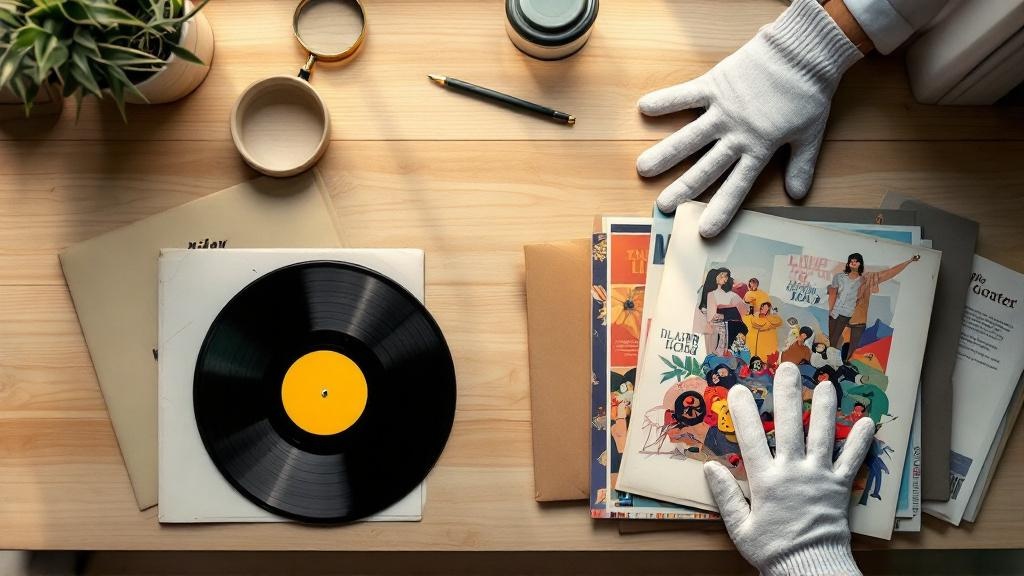
Laying records out flat reveals what collectors really care about—condition, pressing details, and whether all the original extras are still there.
Step 3
Valuing Records Without Losing Weeks
Valuation can easily turn into a rabbit hole. To keep selling vinyl records: what you need is a fast, repeatable method, not a perfect one.
Use this three‑step approach for Bucket A records:
- Identify the exact pressing
- Check the label, catalog number on the spine or back cover, and any barcodes.
- Look at the runout or matrix numbers etched near the center label.
- Compare these details with a reliable vinyl record price guide online or catalog database.
- Look at sold prices, not asking prices
- For selling vinyl records: what matters is what buyers actually paid, not hopeful listings.
- Filter to copies in similar condition (NM vs VG+ makes a big difference).
- Note the typical range rather than the single highest sale.
- Adjust for your grading and venue
- If most recent VG+ copies sell around $25, a solid VG copy might be $15–18.
- Common but desirable LPs often settle around $10–20 in good shape, based on typical shop pricing.
- Expect somewhat lower prices if you sell in bulk locally instead of to global collectors.
Credence Research and Technavio both describe a global vinyl market that could grow toward $1 billion with double‑digit annual growth.[2] That supports patient pricing on truly collectible items. At the same time, you gain nothing by overpricing a common title that hundreds of other sellers list.
For Bucket B, spot‑check a few titles. If multiple albums seem to land under $8–10 each online after fees, selling vinyl records: what probably makes sense is bundling them into lots or selling to a local store for a single offer.
Step 4
Selling Vinyl Records: What Marketplace Fits Best
Choosing where to sell is as important as what you sell. When you think about selling vinyl records: what marketplace you pick affects price, effort, speed, and risk.
Here is a simple “where should I sell this record?” flow:
- High‑value, collectible title, and you are willing to ship worldwide? Use a specialist or major online marketplace.
- Midrange record, some local demand, and you want it gone this weekend? Choose local channels or a record store.
- You are an artist or label selling your own releases? Direct‑to‑fan platforms and your own store usually win.
Online retail is now the fastest‑growing distribution channel for vinyl. That supports using specialist and general marketplaces for anything with real collector interest.
To keep selling vinyl records: what you want is a clear fit between your goals and each channel:
- Specialist online collectors’ sites – best for maximum price on rarities, pure collector audience, clear grading expectations, but more effort and pickier buyers.
- General online marketplaces – huge reach, flexible formats (auction vs fixed price), but fees, competition, and more potential for returns.
- Local classifieds and social apps – low fees and quick cash, good for large lots, but more no‑shows and haggling.
- Local record stores and fairs – instant cash, no shipping, great for bulk, though payouts are lower because stores need margin.
“
The best channel is not “the biggest site,” it is the one that matches your record, your patience, and your risk tolerance.
Your aim with selling vinyl records: what marketplace you use for each record or batch should follow a simple rule of thumb: the rarer and more valuable the record, the more it makes sense to reach serious collectors online rather than rush a local sale.[3]
Channel Picker
Marketplace Comparison Table
This is where selling vinyl records: what channel to choose becomes concrete. Use this table as a quick reference for a single record or for whole batches.
| Channel Type | Best For | Effort Level | Typical Payout | Risk Profile |
|---|---|---|---|---|
| Specialist Online | Rare, high‑value records | High | Highest | Disputes, picky |
| General Marketplace | Popular mid‑ to high‑value | Medium | High | Returns, fees |
| Local Apps | Bulk, midrange collections | Medium | Medium | No‑shows, haggling |
| Record Store | Large, mixed collections | Low | Lower | Low, instant cash |
| Auction House | Very rare, elite collections | High | Very high | Commission, delays |
When you weigh selling vinyl records: what stands out is that higher prices usually require higher effort and patience. If you need cash this week, a local record shop or lot sale might beat chasing the last 15% of value online.
Technavio and Credence Research both point out that specialist and online channels should keep growing faster than traditional outlets.[4] That trend supports building basic skills on at least one online marketplace, even if you start with a small subset of your collection.
Step 5
Preparing Records and Listings
Once you choose channels, preparing records properly is the next big step in selling vinyl records: what you do here directly affects feedback, repeat buyers, and returns.
Start with grading:
- Clean the record gently with a soft, lint‑free cloth or proper cleaning solution.
- Play‑test anything you grade as Near Mint or VG+ if possible.
- Use simple, honest terms: “VG+ record, light surface marks, plays with very minor noise in quiet sections” is better than vague claims.
For each listing, capture consistent details:
- Artist, title, and main contributors
- Label and catalog number
- Country and approximate year of pressing
- Clear condition grades for vinyl and sleeve
- Any extras: posters, inserts, download codes (note if used), stickers
- Any flaws: ringwear, seam splits, writing, warps, audible clicks
To support selling vinyl records: what buyers often want is visual proof. Take good photos in natural light:
- Front and back cover, flat and square in frame
- Close‑up of labels on both sides
- Photos of matrix numbers for more valuable records
- Close‑ups of flaws and special features like colored vinyl or inserts
If you imagine your listing as a simple “sample listing screenshot,” it will usually include all the fields above and 5–8 clear photos. The more a buyer can see, the less likely they are to complain later.
Step 6
Pricing and Sales Strategy
You already have value ranges from earlier research. Now, for selling vinyl records: what you must decide is list price, discount strategy, and format.
Use sold‑price ranges as anchors:
- For a record that regularly sells between $20 and $30 in VG+, listing around $27 with “offers allowed” gives room to negotiate.
- For very hot titles with rising prices, consider starting near the top of the range and reviewing weekly.
- For slow movers, price toward the lower half from the beginning.
Decide between auction and fixed price:
- Auction can work well when demand is obvious: many recent sales, active watch counts on similar items, or a genuinely rare pressing.
- Fixed price is better for steady but not explosive demand, or when you have a clear target price based on research.
When you consider selling vinyl records: what many sellers miss is shipping cost impact. Buyers often filter by total cost, not just item price. To stay competitive:
- Weigh a packed single LP (around 1–1.3 lb in sturdy mailer) and typical 2LP set.
- Offer fair, clearly stated shipping, and consider combined shipping discounts.
- Avoid undercharging so much that shipping eats your margin, especially on cheaper records.
If a record does not sell after 30–60 days, adjust: lower price slightly, refresh photos, or move it from online listing to a local lot if demand seems weak.
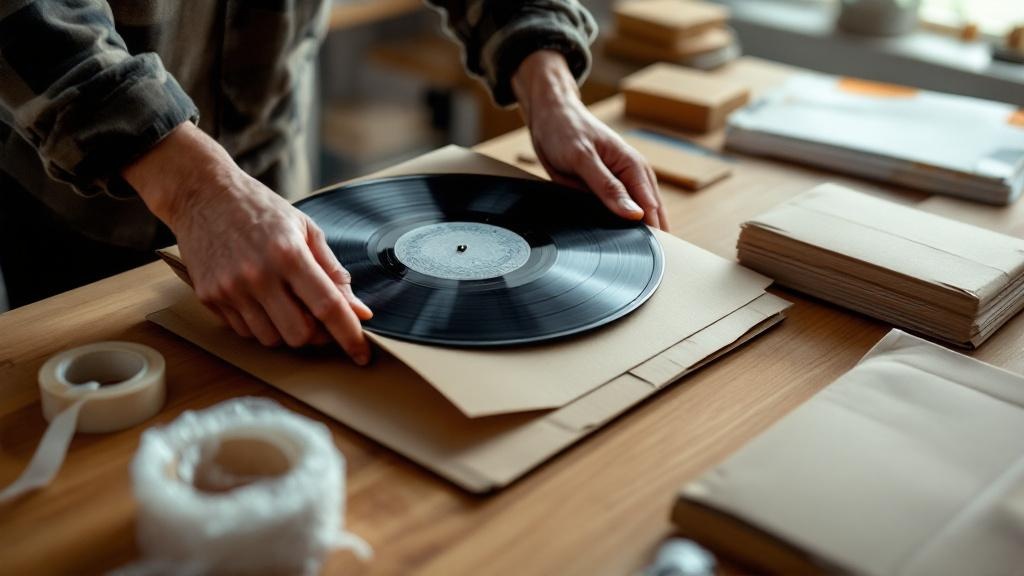
Thoughtful packing turns a successful sale into a smooth experience, protecting your records in transit and your reputation on every marketplace.
Step 7
Shipping, Packaging, and After-Sale Care
Safe shipping is central to selling vinyl records: what might look fine in a photo can arrive split or warped if you pack it poorly.
Use this basic packing method:
- Remove the record from the jacket, keep it in the inner sleeve.
- Place both in a new poly sleeve, with the record behind the jacket to prevent seam splits.
- Sandwich everything between two cardboard stiffeners.
- Use a purpose‑made record mailer that fits snugly.
- Add corner protection or extra padding for higher‑value items.
A single LP in proper packaging often weighs around 590 g to 2 lb, depending on extras. That matters for accurate postage and deciding when to add tracking or insurance. For selling vinyl records: what makes sense is tracking on almost all overseas and mid‑ to high‑value shipments, and insurance on anything that would seriously hurt your budget if lost.
After the sale:
- Communicate clearly: confirm payment receipt, provide shipping estimates, and send tracking promptly.
- Ship quickly, ideally within one business day, to build a strong seller reputation.
- Handle issues calmly; sometimes a partial refund for minor grading disagreements is cheaper than a full return.
Step 8
Common Pitfalls To Avoid
Many frustrations around selling vinyl records: what went wrong stories online come from the same patterns. You can avoid most of them.
Typical mistakes across channels:
- Overpricing because of sentimental value – buyers pay for the record, not your memories.
- Inaccurate or generous grading – calling a VG record NM invites disputes.
- Sparse descriptions – “used but good” tells buyers nothing.
- Weak packaging – records sent in thin boxes or with no stiffeners often arrive damaged.
- Ignoring shipping costs – you lose money if postage exceeds what you charged.
Channel‑specific red flags:
- Specialist and general online marketplaces
- Not reading selling policies, which can lead to unwanted returns or chargebacks.
- Cancelling orders when you mis‑priced something, risking negative feedback.
- Local apps and social platforms
- Buyers who refuse to meet in public places.
- Constant lowball offers; decide your minimum and be willing to walk away.
- Record stores
- Expecting full retail prices; shops must leave room for profit and overhead.
- Hiding damage; a professional buyer will notice and adjust their offer.
RIAA and Zion Market Research both describe a market where vinyl is now a major share of physical music revenue and online channels keep growing. That means more buyers—but also more experienced sellers. To stay competitive when selling vinyl records: what helps most is honest grading, clear photos, and realistic expectations.
Step 9
Going Beyond: Turning Selling Into a Side Hustle
If you enjoy the process and have a steady source of collections, you can turn selling vinyl records: what started as decluttering into a part‑time business.
Start with simple systems:
- Maintain a spreadsheet with artist, title, catalog number, grade, cost, and sale price.
- Assign inventory numbers that match labels on your physical storage, so you can find records quickly after a sale.
- Track fees and shipping costs, not just sale prices, to see real profit.
As you grow, consider:
- Cross‑listing higher‑value items on more than one marketplace, while keeping stock synced to avoid double‑selling.
- Specializing in genres you know well, which speeds up grading and pricing.
- If you are an artist or small label, combining online marketplaces with direct‑to‑fan platforms and select record shops, a path Precision Pressing often highlights for independent releases.
Credence Research and Technavio both expect strong growth in global vinyl, which supports building long‑term skills. For repeat selling vinyl records: what sets successful small sellers apart is consistent grading, strong communication, and careful packaging, not secret tricks.
How do I know what my vinyl records are worth?
Check the exact pressing, then look up recent sold prices in similar condition on a reliable price guide or marketplace. Focus on completed sales, not asking prices. If most copies sell under $10, it is usually a midrange or low‑value record.
What do collectors look for when buying records?
Collectors focus on pressing details, condition, and completeness. They want the specific edition they care about, with clean vinyl, solid jackets, and original inserts when possible. Age alone rarely guarantees value.
Is it better to sell my collection as a whole or one‑by‑one?
For a small batch of valuable titles, individual listings often earn more. For hundreds of mixed, common records, selling in lots or to a record shop saves time and stress. Many sellers combine both: list the top 10–20 titles individually and move the rest as bulk.
Can I sell damaged or heavily worn records?
Yes, but only if you describe them honestly and price appropriately. Some buyers want cheap play copies or rare records even in rough shape. Anything warped, cracked, or moldy usually belongs in the trash or a craft pile, not in a sale.
How do I sell a large vinyl collection quickly?
Sort out any obviously valuable records to sell individually, then offer the rest as a bulk lot to local buyers or record stores. Be realistic about price, since the buyer is taking on sorting, storage, and selling work. Speed almost always means accepting less money.
Should I clean records before selling them?
Light cleaning is a good idea, especially if dust or fingerprints are visible. Use a soft, lint‑free cloth or proper record cleaning solution. Avoid harsh household cleaners that can damage grooves or labels.
Do reissues hurt the value of original pressings?
Mass‑market reissues can cap demand for worn original copies of some albums. However, clean originals of important titles often keep strong value, especially early pressings or special editions. Mention clearly whether your record is an original or later reissue.
Which genres and eras tend to sell best?
There is steady demand for classic rock, soul, funk, jazz, punk, metal, hip‑hop, electronic, and key soundtracks from the 60s through 90s. Niche private press and some newer indie titles can also do well. Easy listening, budget compilations, and oversupplied pop are usually slower and cheaper.
What is the safest way to ship vinyl records?
Use a sturdy record mailer, keep the vinyl outside the jacket in its inner sleeve, and add cardboard stiffeners. Seal all edges with tape, and use tracking, especially for overseas or higher‑value shipments. This approach minimizes damage and protects you in case of postal issues.
When is it worth paying marketplace fees?
Fees are usually worth paying when a marketplace gives you better prices or much faster sales. For a rare $200 record, paying fees for access to serious collectors is reasonable. For a $5 common LP, local cash sales or bundles are often better.
Your Next Step
Conclusion and Practical Next Moves
You now have a practical roadmap for Selling Your Vinyl Records: What Collectors Look For and Where to Start. The key is to respect collector priorities—pressing, condition, completeness, and real demand—while matching each record to the right channel for your goals.
Start small: pick ten records from Bucket A, research their value, choose one marketplace, and create honest, detailed listings. As you learn what sells quickly and what stalls, refine your pricing and decide which midrange records belong online and which should move locally.
Once your listings are up, careful packing and clear communication finish the job. When you are ready, you can treat this as an occasional declutter or build a steady side hustle. And whenever you shop online yourself, remember that pairing the right card rewards with platforms like Oodlz cashback can quietly add extra dollars back into your pocket on every turntable, mailer, or cleaning kit you buy.